The WebTSM Services API
The HAKOM WebTSM Services API provides a state-of-the-art interface for the interaction with time series and master data (like definitions, attributes, users etc.). The interface complies with the following REST architectural principles:
-
Client-server model: separation of user interface from the data management.
Processing multiple HAKOM TSM data sources (repositories) can by one service. -
Stateless: each request contains all necessary information to complete the task.
This allows a microservices architecture utilizing a loadbalancer etc. where each service can be operated and scaled independently from other services. -
Caching: it is possible to cache requests or responses for better performance.
-
Uniform interface: each request follows a uniform model, with uniform messages (including HTTP status codes).
Communication is done via standard HTTP interfaces and a JSON data exchange format.
Features
The REST API eases system integration with the following key features:
-
Platform independence: due to .NET Core support, the service can be operated on Windows, Linux, Azure (App), or in Docker (Linux).
-
Extensions / Extensibility: specific requirements for the interaction with time series data or other services can be provided or integrated as HAKOM WebTSM Services API Extension independent from our release cycle.
-
Latest authentication standards: by means of OAuth 2.0 the service offers modern and especially secure authentication methods
-
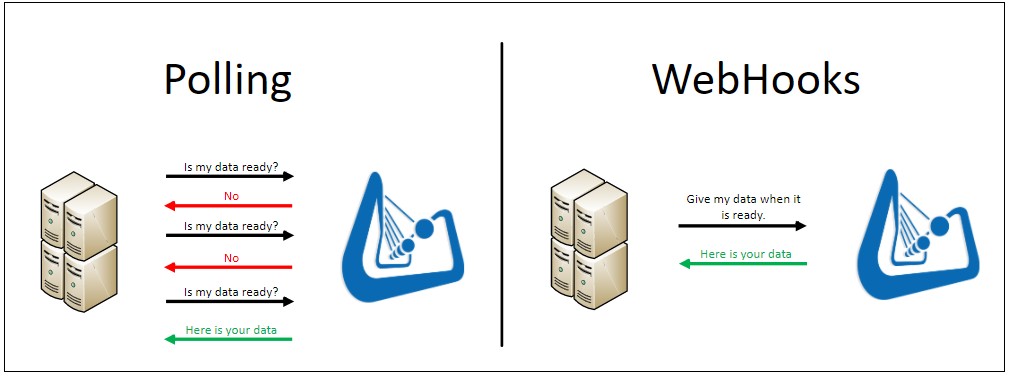
Events via WebHooks: events enable business processes to be executed in a timely, resource-efficient manner in response to certain predefined events.